Fairphone
A smartphone you're meant to open up, not send back.
Read case study →Guiding questionHow do designers minimise waste and reduce product waste and pollution?
Take, make, use, throw away. That sequence is so normal it is easy to miss how recent and how strange it is, and the circular economy is an attempt to design our way back out of it. The central insight is that waste is not an unfortunate by-product of making things. It is a design decision, taken at the drawing stage, by someone who chose a glued seam over a screwed one or seven mixed polymers over one.
This topic sits in Topic C rather than on a recycling poster because it puts the responsibility in the right place. Recycling asks the consumer to fix a problem after the fact, usually badly and usually too late. A circular approach asks the designer to prevent it, which turns material choices, joining methods and disassembly into environmental decisions rather than purely technical ones. That connects straight to C4.1, and it makes for strong Paper 2 answers, because a question about waste answered with specific design decisions will always beat one answered with good intentions.
Students must be able toCompare and contrast a linear approach and the circular economy.
The linear economy is characterised by the phrase "take, make, consume, dispose." Resources are extracted from the environment, processed into products, consumed, and then discarded (sent to landfill or incineration) at the end of their life. This model relies on non-renewable energy and generates large volumes of waste. It treats resources as unlimited and end-of-life as inevitable.
The circular economy is a closed-loop system where resources are continuously repurposed, mimicking the closed nutrient cycles of biological ecosystems. Kirchherr et al. (2017) define it as an economic system that replaces the "end-of-life" concept with reducing, reusing, recycling, and recovering materials in production, distribution, and consumption processes. It relies on renewable energy, and examples of materials in circular use include PET beverage bottles (collected, shredded, and remanufactured into new bottles or textiles) and paper and cardboard (continuously recycled into new paper products).
Key comparison:
Policy context: In 2020, the European Commission adopted a Circular Economy Action Plan as part of the European Green Deal, targeting climate neutrality (net-zero greenhouse gas emissions) by 2050 and a halt to biodiversity loss by 2025. China uses five-year plan cycles to review and revise its sustainability goals and circular economy targets, embedding them into national economic planning.
Hover, focus or tap a stage to see what actually happens there.
Students must be able toDiscuss how designers can design products in ways that eliminate waste and pollution, including designing for longevity, upgradability, disassembly and dematerialisation.
Tackling waste early, at the design stage itself, is far more effective than trying to manage it after a product exists, and this is the thinking behind design-for-manufacture (DFM) guidelines. Designers use a family of "design-for" strategies to eliminate waste and pollution across the full product life cycle:
Dematerialisation describes a steady drop in how much energy or material it takes to deliver the same product or service over time. Examples include email replacing fax and physical surface mail, miniaturisation of electronics, and streaming services replacing physical discs. Dematerialisation directly supports the circular economy by reducing resource inputs per unit of value delivered.
Jevons' Paradox (rebound effect): In 1865, English economist William Stanley Jevons observed that more efficient steam engines led to increased total coal consumption, not a reduction. Cheaper, more effective steam power expanded into new applications (more factories, trains, ships), so total coal use rose even though each engine used less fuel per unit of work. Designers must be aware that efficiency improvements alone cannot be assumed to reduce total resource consumption. If a more fuel-efficient car makes driving cheaper, users may drive more often or further, partially or fully offsetting the gain. Systemic responses and behavioural design (e.g., full-load prompts on appliances) are needed alongside dematerialisation.
Recycling a PET bottle isn't really a closed loop. Every recycling pass loses some material quality (a process called downcycling), the collection, sorting and reprocessing steps consume energy and water of their own, and most plastic labelled "recyclable" is only recycled once or twice, if at all, before it's landfilled or incinerated anyway. A genuine closed loop, glass or aluminium recycled indefinitely without quality loss, is the exception, not the rule.
Does a product that gets recycled once, then landfilled, belong anywhere near the word "circular"? Where would you draw the line between a true circular economy and a linear economy that just has one extra, partially effective step bolted onto the end of it?
Students must be able toDiscuss why biodegradable materials are a preferred material in a circular economy model.
Biodegradable materials break down through natural biological processes (decomposed by microorganisms) into water, minerals, and organic matter. This end-of-life pathway is fundamentally different from conventional synthetic plastics, which persist in the environment for hundreds of years, fragmenting into microplastics that enter food chains and waterways.
Why biodegradable materials are preferred in a circular economy:
Limitations: Not all biodegradable materials break down under ordinary conditions. Some require industrial composting facilities (specific temperature, humidity, and microbial conditions) that may not exist in the disposal location. Designers must specify the correct end-of-life pathway and ensure it is accessible to users: labelling alone is insufficient if the infrastructure does not exist.
Students must be able toDiscuss how designers can consider the recovery and restoration of products, components and materials through take-back legislation, reuse, repair, recondition or recycling.
Circular economy thinking requires designers to plan the entire product life cycle (including what happens to the product, its components, and its materials when the user is finished with it). Recovery and restoration form the closing loop of circular design:
Take-back legislation places legal responsibility on manufacturers to recover products at end of life. Examples include the EU Waste Electrical and Electronic Equipment (WEEE) Directive (requiring manufacturers to fund and organise collection and recycling of electronics) and extended producer responsibility (EPR) schemes for packaging. Take-back legislation creates an economic incentive for designers to design for disassembly and recyclability: the manufacturer pays for end-of-life handling, so reducing that cost requires designing products that are cheap to recover.
Extended Producer Responsibility is a policy principle that makes the manufacturer of a product financially and physically responsible for that product once the consumer is finished with it, rather than leaving disposal entirely to local waste authorities or the consumer. In practice this usually means the manufacturer must fund, organise or directly operate the collection, recycling or safe disposal of its own products at end of life.
EPR changes the economics of design described elsewhere in this objective: when a manufacturer knows it will personally bear the cost of recovering a product, a difficult-to-disassemble design becomes a direct cost on the company's own balance sheet rather than a cost hidden in someone else's landfill bill. This is why take-back legislation and EPR schemes create a financial incentive to design for disassembly, single-material components and standardised fasteners.
A smartphone you're meant to open up, not send back.
Read case study →Students must be able toIdentify renewable energy sources and discuss why the circular economy relies on the use of renewable energy.
Renewable energy sources are those that are naturally replenished on human timescales and do not deplete a finite stock:
Why the circular economy depends on renewable energy: The circular economy's goal is to eliminate waste and pollution across the full system: not just the product, but the energy used to make, process, and recycle it. Fossil fuels are finite and produce greenhouse gas emissions that accumulate in the atmosphere as a form of irreversible waste. A circular economy powered by fossil fuels is not truly circular because:
Renewable energy provides the continuous energy flow required by circular processes (recycling, remanufacturing, composting, take-back logistics) without depleting finite resources or generating waste that cannot be managed within the system.
Ten questions covering all five learning objectives, from the linear and circular models through to recovery, restoration and renewable energy. Select one answer per question, then click "Check all answers" to see your score and the explanations.
A dairy delivers milk in glass bottles to doorsteps. The customer rinses the empty bottle and leaves it out; the dairy collects it, washes it at 85 °C, inspects it and refills it. A bottle that fails inspection is crushed and returned to a glass furnace.
The same dairy also sells milk in plastic bottles through supermarkets.
Table 1: The two containers compared
| Glass, returned | Plastic, kerbside recycled | |
|---|---|---|
| Mass empty | 400 g | 28 g |
| Mean trips before retirement | 25 | 1 |
| Energy per trip | Washing only, after first manufacture | Full manufacture each time |
| Return rate | 94 % | — |
| Recycled into | New bottles | Fibre, pipe, lower-grade products |
| Delivery | Local round, electric float | National distribution |
(a) State whether the glass bottle system is an example of reuse or recycling, see Table 1. [1]
(b) Outline why the plastic bottle's recycling route in Table 1 is described as downcycling. [2]
(c) Explain why the 94 % return rate is the figure that determines whether the glass system works, see Table 1. [3]
(a) Reuse. The bottle returns to the same function without being reprocessed.
(b) The plastic does not become a new milk bottle; it becomes fibre or pipe, which is a lower-value product that cannot itself be recycled into anything similar again. Each cycle therefore moves the material a step down and the loop terminates, so recycled plastic delays disposal rather than closing the loop.
(c) A glass bottle weighs 400 g against 28 g, so it carries roughly fourteen times the material and manufacturing energy of a plastic one, and the whole case for it rests on spreading that cost over 25 trips. If bottles are not returned they cannot make those trips, and the system loses its only advantage. The arithmetic is unforgiving: at a 94 % return rate the dairy has to replace 6 % of its fleet each cycle, and every replacement is a fresh 400 g of glass melted and moulded. Return rate also determines the size of the fleet the dairy must own and wash, so it drives the cost of running the system as well as its environmental case. This is the general point about a circular economy: the loop only closes if the material actually comes back, and the design of the return route matters as much as the design of the product. That is why doorstep delivery works, since collection happens on a round that is being driven anyway, whereas a supermarket-bought glass bottle would depend on the customer carrying it back.
(a) • Reuse ✓
Award [1] for the correct classification up to [1 max].
(b) An objective of the circular economy is to recover and restore products, components and materials.
• The plastic does not become a new milk bottle ✓
• It becomes fibre, pipe or another lower-grade product ✓
• The recovered material is of lower value than the original ✓
• The lower-grade product cannot itself be recycled into anything similar ✓
• Each cycle moves the material a step down and the loop terminates ✓
• Virgin plastic is still required to make the next bottle ✓
• Downcycling delays disposal rather than closing the loop ✓
Award [1] for each relevant brief point explaining downcycling up to [2 max]. Contrast with the glass, which is recycled into new bottles.
(c) A circular economy is a closed-loop system where resources are continuously repurposed.
• The glass bottle weighs 400 g against 28 g, roughly fourteen times the material ✓
• Its manufacturing energy is correspondingly higher ✓
• The whole case for it depends on spreading that cost over 25 trips ✓
• A bottle that is not returned cannot make those trips ✓
• At 94 % the dairy replaces 6 % of its fleet each cycle ✓
• Every replacement is a fresh 400 g of glass melted and moulded ✓
• A falling return rate would make glass worse than plastic per litre delivered ✓
• Return rate also sets the fleet size the dairy must own and wash, so it drives cost ✓
• The loop only closes if the material comes back, so the return route is part of the design ✓
• Doorstep collection works because it happens on a round already being driven ✓
Award [1] for each relevant reason / cause explaining why the return rate is decisive up to [3 max]. Credit responses that reason from the mass difference in Table 1.
A packaging company grows protective packaging from mycelium, the root structure of fungi. Agricultural waste such as hemp hurd is packed into a mould and inoculated. Over five days the mycelium grows through the waste and binds it into a solid form. The part is then heated to kill the organism.
It replaces expanded polystyrene used to protect electronics in transit.
Table 2: Mycelium packaging compared with expanded polystyrene
| Mycelium | Expanded polystyrene | |
|---|---|---|
| Feedstock | Agricultural waste | Petrochemical |
| Production energy | Low, ambient growth | High, steam expansion |
| Density | 60 kg/m³ | 16 kg/m³ |
| Compressive strength | Adequate for most loads | Higher |
| Moisture resistance | Poor | Excellent |
| Disposal | Home compostable in 45 days | Persists; rarely recycled |
| Lead time | 5 days growth per batch | Minutes per part |
(a) State the circular economy objective served by a material that is home compostable, see Table 2. [1]
(b) Identify two limitations of mycelium packaging for a manufacturer shipping worldwide, see Table 2. [2]
(c) Evaluate mycelium packaging as a replacement for expanded polystyrene, see Table 2. [3]
(a) Incorporating biodegradable materials, so the material returns to the biological cycle.
(b) Poor moisture resistance, which matters on a long sea route through humid conditions; and a five-day growth time per batch, which makes it hard to respond to a change in shipping volume.
(c) The environmental case is strong and it is strong in the right place. The feedstock is agricultural waste rather than oil, production happens at ambient temperature, and disposal needs no collection system at all, because the customer composts it at home in 45 days. That last point matters most, since polystyrene's real failure is that it is technically recyclable and almost never recycled, so a material that decomposes wherever it ends up removes the dependence on infrastructure that does not exist. Against that, it is nearly four times as dense, so more mass is shipped for the same protection, and its moisture resistance is poor, which is a genuine functional failure for goods crossing an ocean rather than a minor drawback. The five-day lead time also forces a manufacturer to hold stock and forecast demand rather than mould parts as needed. On balance it is a good replacement for regional shipping of goods that are not moisture sensitive, and not yet a general substitute, because for a humid sea route the packaging has to survive the journey before its disposal advantage is worth anything.
(a) • To incorporate biodegradable materials ✓
• Returning material to the biological cycle ✓
• Eliminating waste ✓
Award [1] for the correct circular economy objective up to [1 max].
(b) • Poor moisture resistance on a long or humid route ✓
• Five day growth time per batch limits responsiveness ✓
• Density of 60 kg/m³ against 16 means more mass shipped ✓
• Lower compressive strength for heavy or dense goods ✓
• Growth facilities must be near the packing site or the parts shipped ✓
• Biosecurity or import restrictions on fungal material in some countries ✓
Award [1] for each relevant limitation identified up to [2 max]. The limitation must be supported by Table 2 or by the shipping context.
(c) The aim of the circular economy is to eliminate waste and pollution throughout all stages of a product's life cycle.
Strengths:
• Feedstock is agricultural waste rather than a petrochemical ✓
• Production occurs at ambient temperature, so energy use is low ✓
• Home compostable in 45 days, so disposal needs no collection system ✓
• Polystyrene is technically recyclable and almost never recycled, so infrastructure independence is decisive ✓
• Uses a waste stream as an input, which is itself a circular outcome ✓
• No microplastic residue ✓
Limitations:
• Nearly four times the density, so more mass is shipped for the same protection ✓
• Poor moisture resistance is a functional failure for an ocean crossing, not a minor drawback ✓
• Lower compressive strength limits the goods it can protect ✓
• Five day lead time forces stock holding and demand forecasting ✓
• Batch growth cannot respond to a sudden change in volume ✓
Judgment:
• A good replacement for regional shipping of goods that are not moisture sensitive ✓
• Not yet a general substitute, since the packaging must survive the journey first ✓
Award [1] for each distinct strength / limitation, leading to an appraisal of mycelium packaging as a replacement, up to [3 max]. Award a maximum of [2] where only strengths or only limitations are given.
A washing machine manufacturer is redesigning its mid-range model. The current machine has a mean life of seven years. The most common cause of retirement is a failed drum bearing, which is pressed into a sealed plastic outer drum that is not sold as a separate part.
Replacing the bearing requires the complete outer drum assembly, which costs more than half the price of a new machine.
(a) Identify two consequences of sealing the bearing inside a non-replaceable drum. [2]
The new design splits the outer drum into two bolted halves, so the bearing can be pressed out and replaced.
Table 3: Current and proposed machine compared
| Current | Proposed | |
|---|---|---|
| Mean life | 7 years | 14 years |
| Outer drum | Sealed, welded | Two bolted halves |
| Bearing replacement | Whole drum, £190 | Bearing only, £22 |
| Manufacturing cost | £148 | £163 |
| Retail price | £349 | £379 |
| Machines sold per customer over 14 years | 2 | 1 |
(b) Outline how the bolted drum supports design for disassembly, see Table 3. [2]
The manufacturer also proposes publishing repair manuals, selling spare parts to anyone, and using standard fasteners throughout so that a single screwdriver opens the machine.
(c) Describe how these three measures extend the machine's life beyond what the bolted drum alone achieves, see Table 3. [2]
The finance director objects that the proposal costs £15 more to make and halves the number of machines each customer buys.
(d) Explain how the manufacturer could remain profitable while designing for a circular economy, see Table 3. [4]
(a) A single low-cost component failing retires the whole appliance, and the repair is priced so close to replacement that no rational customer chooses it.
(b) Bolts are a reversible joint and a weld is not, so the drum can be opened without destroying it and closed again afterwards. That turns the bearing into a serviceable part costing £22 rather than a £190 assembly, and it means the drum, motor and other components stay in use instead of leaving with the failed bearing.
(c) The bolted drum makes repair physically possible; these three measures make it actually happen. A manual tells someone which part has failed and how to reach it, selling parts to anyone means an independent repairer or the owner can obtain one rather than depending on the manufacturer's own service network, and standard fasteners mean the job needs no proprietary tool. Without all three, a repairable machine is repairable only in principle.
(d) The objection assumes the company sells machines, and the way to stay profitable is to change what it sells.
The direct answer is that the margin rises on each sale. Cost goes up £15 and price goes up £30, so the proposed machine earns £15 more per unit than the current one. Selling half as many at a higher margin narrows the gap considerably before anything else changes.
The lost volume can be replaced with revenue the current design forgoes. A machine that is worth repairing generates fourteen years of spare part sales at £22 a bearing plus pumps, belts and seals, and those parts carry good margins. The manufacturer currently sells none of that, because at £190 the customer buys a new machine from whoever is cheapest, so the repair market is revenue the sealed design gives away.
The stronger move is to stop selling the machine at all and sell laundry instead, leasing the appliance for a monthly fee and retaining ownership. Under that model a long life becomes an asset rather than a loss, because every extra year is another year of income from hardware already paid for, and the incentives of the business and the circular economy point the same way. It also guarantees the machine returns to the manufacturer at end of life, which is where the material recovery in a circular economy actually happens.
Finally, the fourteen-year machine changes what the brand is. A washing machine is bought on a reputation for lasting, so durability that is demonstrable is a marketing asset, and it protects against regulation, since repairability requirements and spare part obligations are tightening and a company that has already designed for them is not caught retrofitting.
(a) Designers can eliminate waste through longevity, upgradability, disassembly and dematerialization.
• A single low-cost component failing retires the whole appliance ✓
• Repair costs more than half the price of a new machine, so nobody repairs it ✓
• Working components leave with the failed one ✓
• Materials go to waste while still serviceable ✓
• The customer has no viable choice other than replacement ✓
• Independent repairers are excluded because the part is not sold ✓
Award [1] for each relevant consequence identified up to [2 max].
(b) Design for disassembly considers how components of a product can be separated.
• Bolts are a reversible joint; a weld is not ✓
• The drum can be opened without destroying it and closed again afterwards ✓
• The bearing becomes a serviceable part at £22 rather than a £190 assembly ✓
• Repair becomes economically rational for the owner ✓
• Drum, motor and other components stay in use instead of being retired ✓
• Separable parts can also be sorted by material at end of life ✓
• Mean life doubles from 7 to 14 years ✓
Award [1] for each relevant brief point on how the bolted drum supports disassembly up to [2 max].
(c) An objective of the circular economy is to recover and restore products, components and materials.
• The bolted drum makes repair possible; these measures make it happen ✓
• A manual tells the repairer which part failed and how to reach it ✓
• Diagnosis is often the barrier rather than the physical work ✓
• Selling parts to anyone allows an independent repairer or the owner to obtain one ✓
• It removes dependence on the manufacturer's own service network and its pricing ✓
• Standard fasteners mean no proprietary tool is required ✓
• Without all three the machine is repairable only in principle ✓
Award [1] for each detail, leading to an account of how the three measures extend life beyond the bolted drum, up to [2 max]. Award a maximum of [1] where the response addresses only one measure.
(d) A circular economy is a closed-loop system where resources are continuously repurposed, and business models must be redesigned alongside products.
Margin per unit:
• Cost rises £15 and price rises £30, so margin rises £15 per machine ✓
• Selling half as many at a higher margin narrows the gap before anything else changes ✓
• A demonstrably longer life supports the higher price ✓
Spare parts revenue:
• A repairable machine generates fourteen years of part sales ✓
• Bearings, pumps, belts and seals carry good margins ✓
• The current design gives this revenue away, since at £190 the customer buys a new machine ✓
• That replacement may be from a competitor, so the sealed design risks losing the customer entirely ✓
Product as a service:
• Lease the machine for a monthly fee and retain ownership ✓
• A long life becomes an asset, since every extra year is income from hardware already paid for ✓
• Business incentives and circular economy incentives then point the same way ✓
• Ownership guarantees the machine returns at end of life for material recovery ✓
• Recovered components can be reconditioned into the next machine ✓
Strategic value:
• Durability is a marketing asset in a category bought on reputation for lasting ✓
• Repairability and spare part regulation is tightening, so the design anticipates it ✓
• A company already compliant is not caught retrofitting later ✓
Award [1] for each relevant detail / reason / cause relating to how the manufacturer could remain profitable up to [4 max]. Award a maximum of [3] where the response does not go beyond the unit margin argument. Credit responses that propose a product-as-a-service model.
Linking Questions
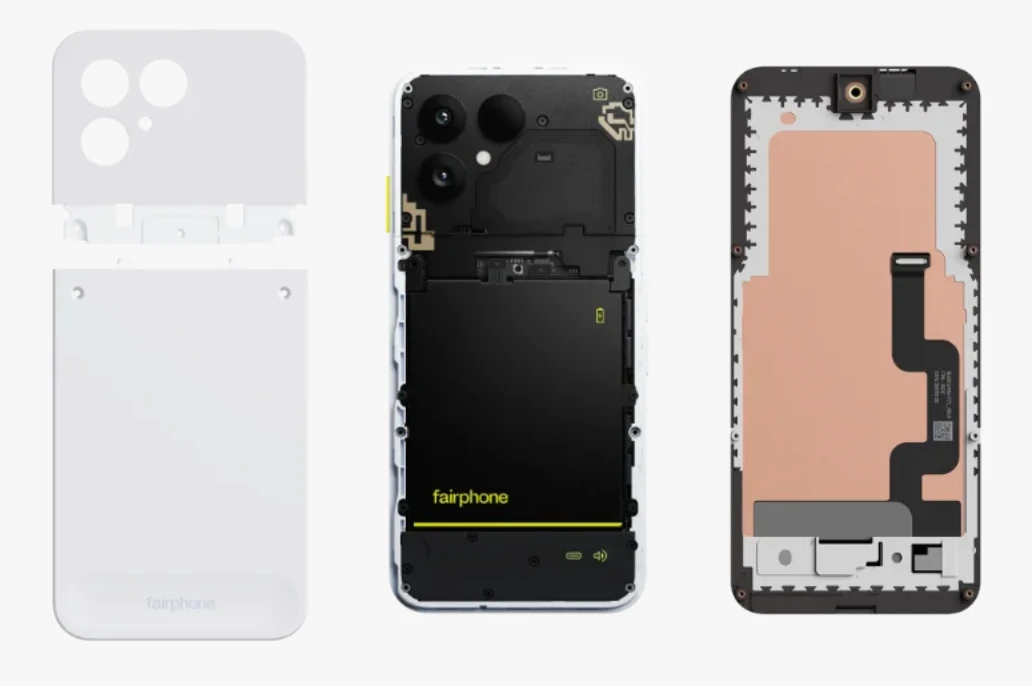
Take the back cover off a Fairphone and the first thing you see is a battery held in by two ordinary screws, not epoxy glue heated with a heat gun. Every major component- the screen, the camera, the speaker, the USB-C port- is its own separate module. Further, each one carries a small icon printed directly on it showing which screwdriver removes it. This is very, very different from an Apple, Huawei, or Samsung phone- where repairability is often limited or impossible.
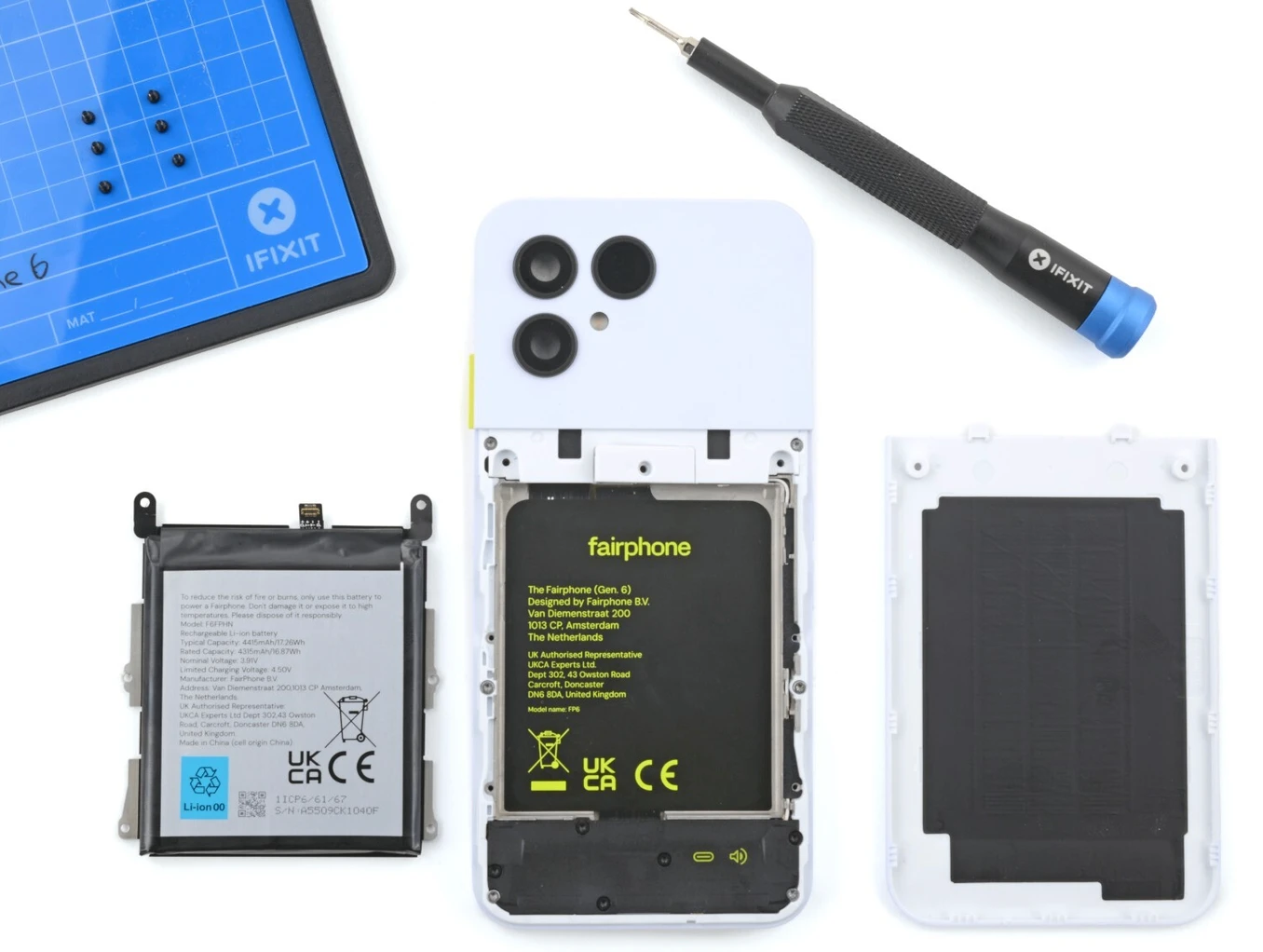
Fairphone sells every one of those modules directly, and publishes exactly how long it commits to supporting each phone with software updates, working directly against the technological obsolescence covered in C1.1. Independent repairability audits from iFixit routinely score Fairphone models 9 or 10 out of 10, compared to scores typically ranging in the 3-6 area for other flagship phones. None of this has made Fairphone a market leader. It remains a small niche brand next to Apple and Samsung, which raises a question: if repairability is genuinely popular with consumers, why hasn't it won?